Related reading
Performance Marketing
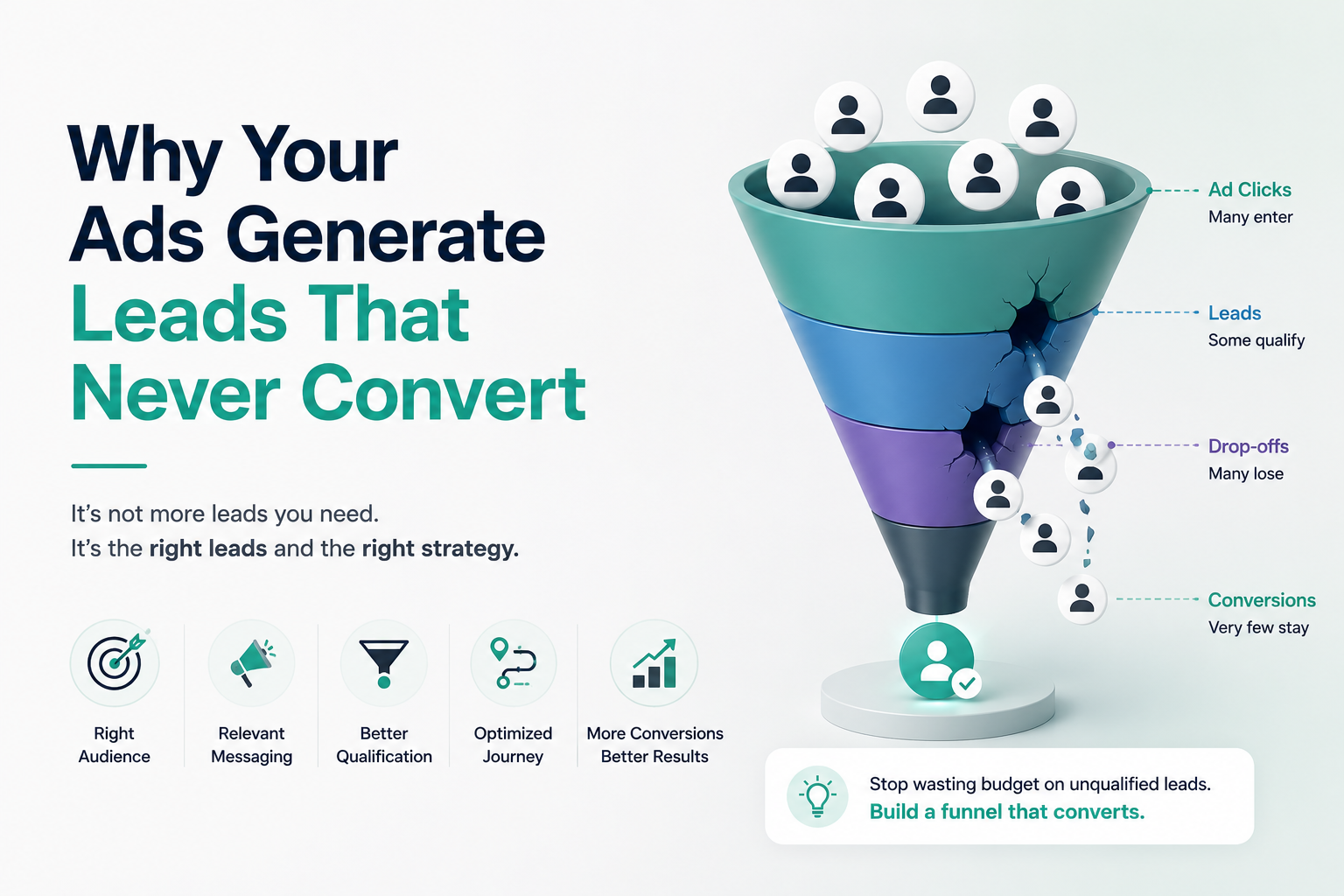
Why Your Ads Generate Leads That Never Convert

Performance Marketing
Scaling an online store is easy if you ignore contribution margin. We build campaigns around what you actually keep after ad spend, returns and shipping.
Break-even ROAS
is determined by gross margin, return rate and fulfilment cost — not by an industry benchmark
Source: Unit-economics principle
Repeat purchase
acquiring a new customer typically costs substantially more than selling to an existing one
Source: Widely replicated retention research
Checkout friction
cart abandonment is consistently among the largest recoverable revenue losses in e-commerce
Source: Baymard Institute
It is straightforward to grow an online store's revenue. Increase the budget, widen the targeting, discount harder, and the top line moves. Whether the business is better off afterwards is an entirely different question — and one a return-on-ad-spend figure cannot answer, because it is calculated on gross revenue before returns, shipping, payment fees and cost of goods.
We plan e-commerce campaigns against contribution margin: what actually remains after all of those costs. That single change usually reveals which products and channels are genuinely funding the business and which are quietly consuming it.
A campaign at 4x ROAS on a category with a 25% gross margin and a 20% return rate can be losing money. In the Indian market, cash-on-delivery adds a further complication — orders that are placed but never accepted still cost you shipping in both directions while never appearing as revenue. Any serious e-commerce measurement has to account for this, and most agency reporting does not.
Blended ROAS conceals the truth, because it mixes in repeat purchases from customers you already paid to acquire. Separating new-customer acquisition cost from returning-customer revenue tells you whether the business is genuinely growing or simply harvesting existing demand more efficiently.
The first order frequently breaks even at best. Profit comes from the second and third, which means email, WhatsApp and SMS flows — abandoned cart, post-purchase, replenishment, win-back — are not a nice-to-have but the mechanism that makes the acquisition maths work at all.
For Shopping and catalogue campaigns, the product feed is the campaign. Titles, attributes, imagery, availability and pricing accuracy determine what you are matched against and how you convert. Feed work is unglamorous and routinely delivers larger gains than creative testing.
Every improvement to product pages, site speed and checkout increases the return on all traffic, paid and organic, permanently. On a store with meaningful volume, removing friction from checkout typically returns more than an equivalent increase in ad budget.
Revenue scales while contribution margin does not, because ROAS was measured before returns, shipping and cost of goods.
Return rates and refused cash-on-delivery orders erode margin invisibly and rarely appear in campaign reporting.
New-customer cost climbs as spend scales, hidden inside a blended figure that mixes in repeat purchases.
Every rupee of revenue paid for again, because there are no flows bringing existing customers back.
Poor titles, attributes and imagery capping Shopping performance regardless of budget.
Campaigns judged on what remains after cost of goods, returns, shipping and fees — the number that decides whether to scale.
Acquisition cost for genuinely new customers reported apart from repeat revenue, so growth is real rather than apparent.
Titles, attributes, imagery and availability tuned, which usually moves Shopping performance more than creative testing.
Abandoned cart, post-purchase, replenishment and win-back sequences over email and WhatsApp, where the profit actually is.
Product page, speed and checkout work that lifts the return on every visitor you already have.
A steady supply of product and lifestyle content, because creative fatigue is the usual cause of decaying performance.
We listen, audit and research — understanding your market, audience and goals before anything else.
We craft a clear, measurable roadmap designed to hit the outcomes that matter to your business.
Our team builds, creates and launches with precision — pairing engineering rigour with bold creativity.
We measure, optimise and double down on what works to compound your growth over time.
If scaling a campaign would cost you money, we will show you the arithmetic and recommend against it.
Indian e-commerce realities built into the model, not discovered at the end of the quarter.
Product photography, lifestyle imagery and video shot in-house, so testing never stalls waiting on assets.
Flows built alongside acquisition, because acquisition alone rarely pays for itself on a first order.
Performance Marketing
Performance Marketing
Tell us your targets and we'll come back with a costed plan — channels, budget split and the cost per lead you should expect. No obligation.
Tell us about your goals. We'll engineer the path to get you there.