Related reading
Performance Marketing
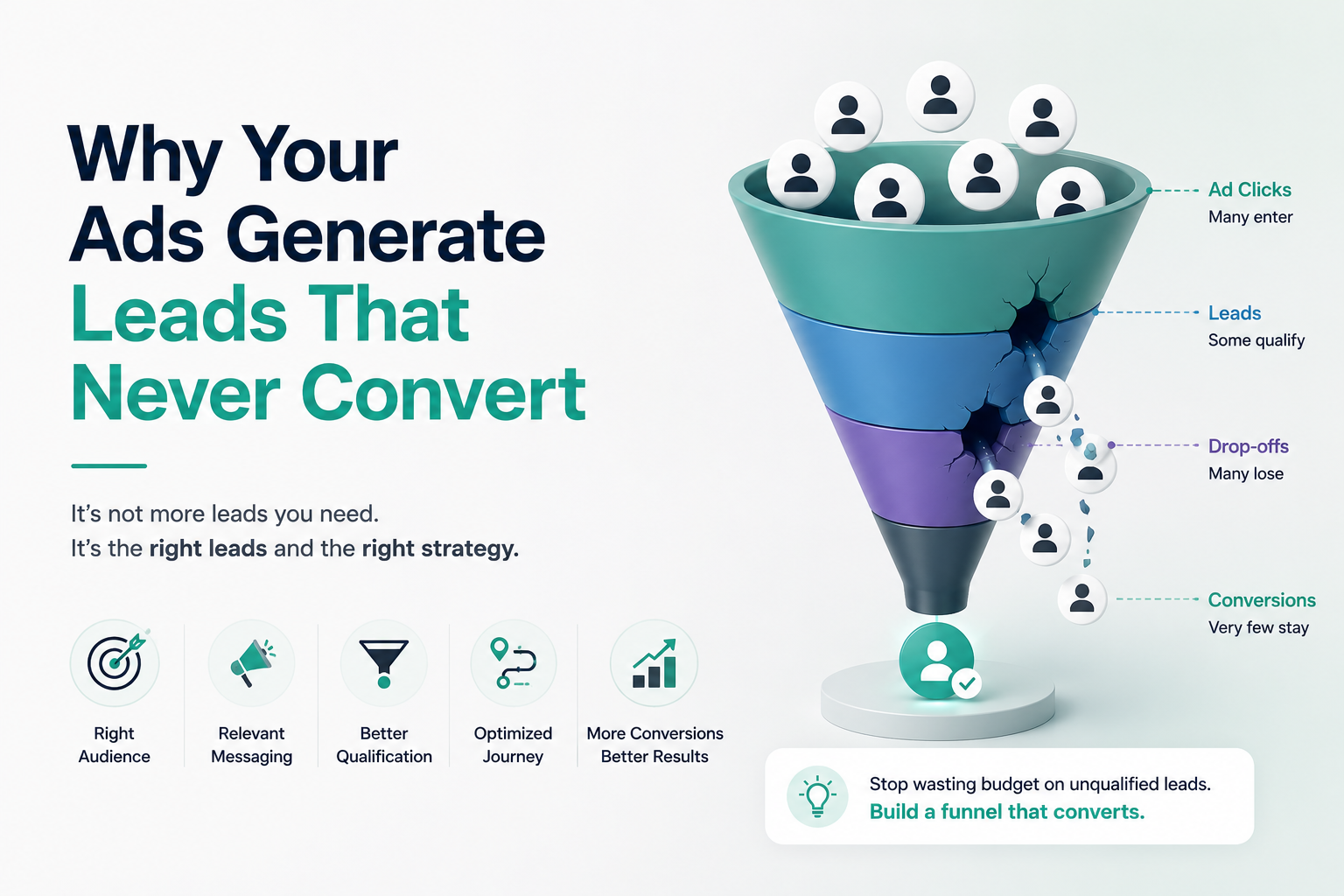
Why Your Ads Generate Leads That Never Convert
Performance Marketing
Most B2B marketing produces leads sales will not call. We build demand generation measured on pipeline and closed revenue, with the two teams working from one definition of quality.
95%
of business buyers are not in-market at any given time
Source: LinkedIn B2B Institute / Ehrenberg-Bass
6–10
decision-makers in a typical complex B2B purchase
Source: Gartner
70%
of the buying process completed before a supplier is contacted
Source: Gartner
In most B2B organisations, marketing reports a healthy number of qualified leads and sales reports that the leads are poor. Both are telling the truth, because they are using different definitions. Marketing counts anyone who downloaded something; sales counts people worth a call. Until those definitions are reconciled, every subsequent argument about budget is unresolvable.
We work from a single agreed definition of a qualified opportunity, instrument the funnel through to closed revenue in your CRM, and report on pipeline contribution rather than lead volume. It is a less flattering number and the only one worth optimising.
At any moment only a small fraction of your potential buyers are actively in-market. The rest will buy eventually, from whoever they remember when the need arises. This is why B2B marketing has two distinct jobs — capturing existing demand now, and building mental availability for the far larger group who will buy later — and why cutting all brand-building activity to fund lead generation reliably improves this quarter and damages next year.
A meaningful B2B purchase involves several people with different anxieties: the user cares about workflow, the technical evaluator about integration, finance about cost, and the executive sponsor about risk. Content aimed only at the economic buyer leaves your internal champion unable to answer the objections raised in the rooms you are not in.
When a customer is worth a great deal and the target list is finite, treating a few hundred named accounts as the market — with tailored content and coordinated sales outreach — is more efficient than broad demand generation. Below a certain deal size the coordination overhead is not worth it, and we will say so.
Long cycles with many touchpoints make single-touch attribution actively misleading. Last-click credits the final search; first-click credits an article read nine months earlier. Neither is the whole story. We use a mix of CRM-based reporting and self-reported attribution — simply asking buyers how they found you — because in long-cycle B2B it is frequently more accurate than the analytics.
Marketing reports qualified leads, sales says they are unusable, and neither definition has ever been reconciled.
Cost per lead falls while pipeline stays flat, because cheaper leads are simply worse leads.
All budget on capture, none on the far larger group who will buy later, so future demand never gets built.
Content addresses one stakeholder while four others with different concerns decide the outcome.
Long cycles and many touchpoints producing numbers that neither team believes, so decisions get made on opinion.
Marketing and sales sign off on what qualified means before any campaign runs, which ends the argument permanently.
Tracking from first touch through to closed revenue, so channels are judged on pipeline rather than form fills.
Budget split deliberately between converting today's buyers and building familiarity among tomorrow's.
Material addressing the user, the technical evaluator, finance and the executive sponsor.
Named-account programmes for high-value segments, coordinated with sales outreach.
CRM data combined with self-reported attribution, because long cycles defeat single-touch models.
We listen, audit and research — understanding your market, audience and goals before anything else.
We craft a clear, measurable roadmap designed to hit the outcomes that matter to your business.
Our team builds, creates and launches with precision — pairing engineering rigour with bold creativity.
We measure, optimise and double down on what works to compound your growth over time.
The most valuable first session is usually getting marketing and sales to agree what a good lead is.
Less flattering than lead counts, and the only measure that supports a budget conversation with a CFO.
We will argue against cutting all brand activity to hit a quarterly lead target, and show you why.
If account-based marketing is not worth the overhead at your deal size, we will tell you rather than sell it.
Performance Marketing
Performance Marketing
Tell us your targets and we'll come back with a costed plan — channels, budget split and the cost per lead you should expect. No obligation.
Tell us about your goals. We'll engineer the path to get you there.