Click-to-WhatsApp Campaigns: When They Beat Lead Forms
A lead form takes a phone number and puts it in a queue. Someone calls back a day or two later, by which point the interest that made the person click has mostly evaporated.
For a lot of businesses that's fine. For some, it quietly destroys the campaign, and Click-to-WhatsApp is the obvious fix nobody tries until something else has failed.
What a Click-to-WhatsApp campaign actually is
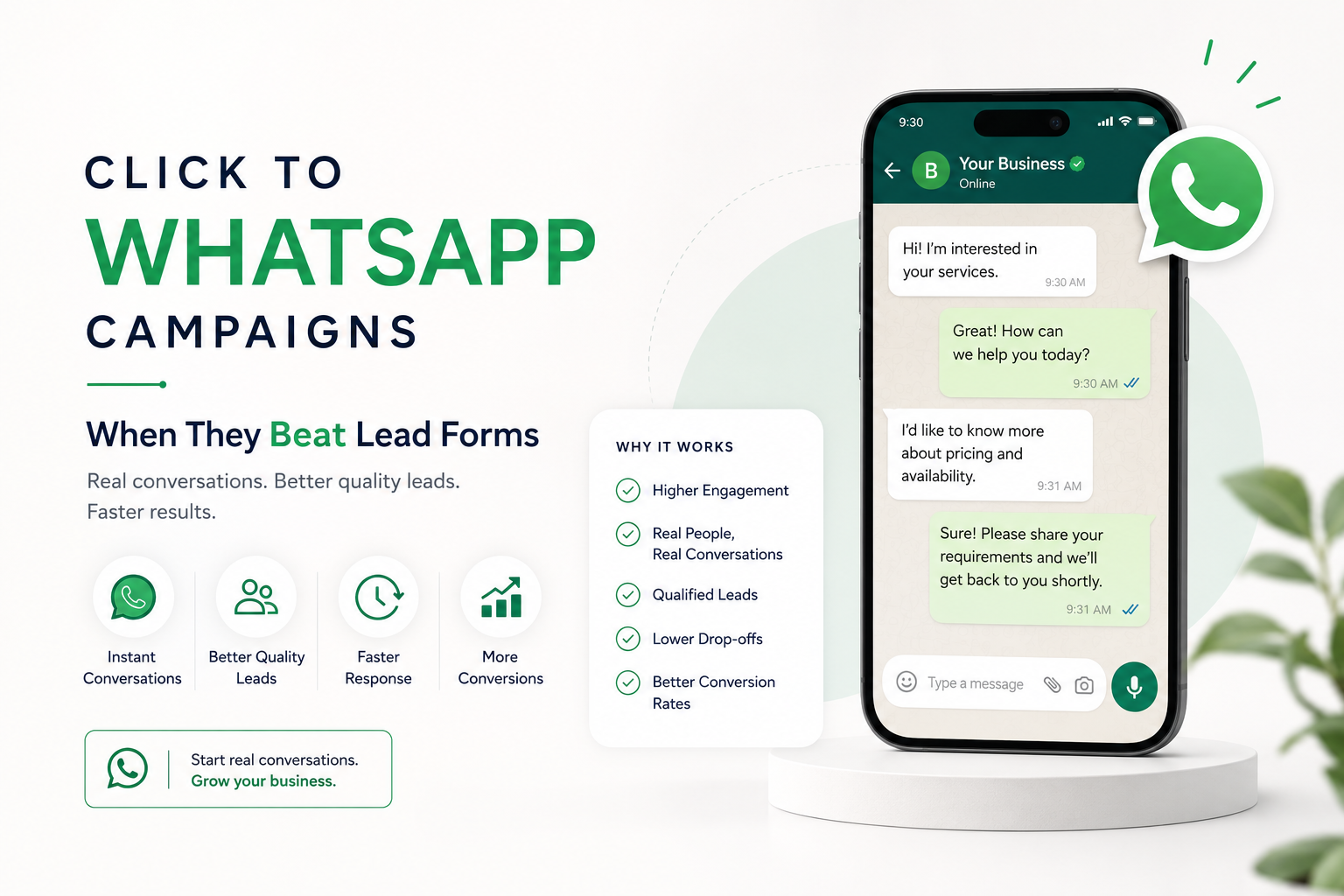
Instead of sending someone to a landing page or an instant form, the ad opens a WhatsApp conversation with your business, usually with a pre-filled first message. The person is in a chat thread within about two seconds of tapping the ad.
The mechanic is simple. What changes is the timing: you're talking to someone at the moment they were interested, not a day and a half afterwards.
When it works well
The purchase has genuine questions attached
If nobody buys without asking something first, a form is the wrong instrument. Courses, property, medical services, travel packages, anything with variants and pricing tiers.
We ran this for a language academy where prospective students needed to know batch timings, fluency levels and fees before committing. Moving the funnel onto WhatsApp produced 200 admissions at 12X return on ad spend. The gain came almost entirely from removing a step that never needed to exist.
WhatsApp is already where your customers are
In India, the Gulf, Southeast Asia, Brazil and much of Africa, WhatsApp is the default way people talk to businesses. Asking someone to fill in a form instead is asking them to use a less convenient channel to reach you.
Speed of response is a real advantage for you
If you can reply within minutes and your competitors call back in two days, this converts that operational advantage into a commercial one.
When it fails
Worth being blunt about this, because it fails in a boringly consistent way.
If nobody is staffing the inbox, do not run it. A WhatsApp lead that goes unanswered for six hours is worse than a form fill, because the person watched their message get delivered and ignored. That is a considered decision not to reply, from their point of view.
Attribution gets harder. Conversations do not fit neatly into conversion tracking, and connecting a chat to a closed deal takes deliberate setup. Expect to do work here.
It scales with headcount, not budget. A landing page handles a thousand visitors as easily as ten. A WhatsApp inbox does not. Doubling spend means roughly doubling the people answering, and that maths needs doing before you scale.
Long-cycle B2B usually does better elsewhere. If your sale takes months and involves procurement, a chat thread is not the right container for it.
What actually made it work
The campaign is the easy part. Three things carried the result:
- Response time. Minutes, not hours. This is the whole advantage and losing it loses everything.
- A real first message. Pre-filled text that opens a conversation rather than a generic "Hi, I'm interested" that tells the agent nothing.
- Nurture for people who go quiet. Most will. A structured follow-up over the following days recovers a meaningful share of them.
Should you test it?
Worth testing if your buyers have questions before purchase, your customers already use WhatsApp, and you can answer within minutes during business hours.
Not worth it if your inbox will sit unattended, your sale is long and multi-stakeholder, or your product is simple enough that nobody needs to ask anything before buying.
Run it against your existing lead form rather than replacing it outright. Compare cost per qualified conversation to cost per qualified lead, not raw volume, because the two channels produce very different-looking numbers for the same underlying demand.
Enjoyed this?
Get a free consultation with our team.